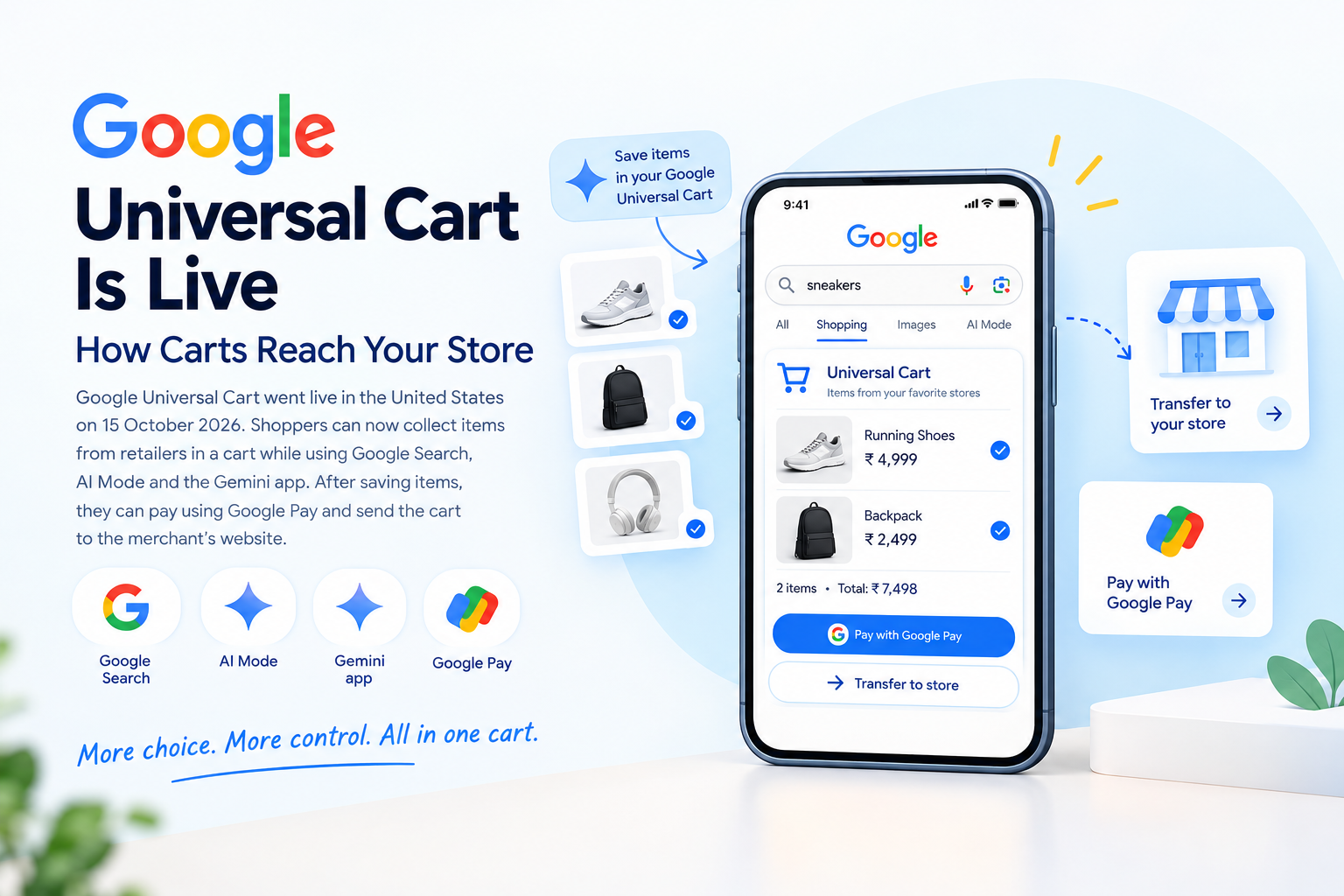
Google Universal Cart went live in the United States on 15 October 2026. Shoppers can now collect items from retailers in a cart while using Google Search, AI Mode, and the Gemini app. After saving items, shoppers can pay using Google Pay. Send the cart to the merchant’s own website. The second option is most important for merchants who own a store. It is called cart transfer. It works through the Universal Commerce Protocol (UCP). I haven’t tested cart transfer on a store yet, so I will focus on what Google documents say and what I would look at first if a client asked me about it. 1. What Is Google Universal Cart and How Does It Work? Google introduced Google Universal Cart at I/O on 19 May 2026. The launch happened five months later. Think of Google Universal Cart as a shared shopping list that lives inside Google and inside one website. According to Google’s launch post, Google Universal Cart does four things: One detail builds trust: the merchant stays the seller of record in both routes. Shoppers still receive order confirmations and support from the merchant, not from Google Universal Cart.Also, Google Universal Cart is not an AI agent that buys items on its own. Google Universal Cart is presented as a tool that gives shoppers control over their purchases. 2. How Google Universal Cart Cart Transfer Works Cart transfer is the way a cart reaches your store. It also requires these steps. Steps Involved in Google Universal Cart Cart Transfer : There is one limitation. Google’s Cart API guide describes this release as one‑way. Google can create a cart on the merchant’s side. It cannot update, delete, or sync that cart afterwards. The native checkout is an API. You do not need it for cart transfer. Google Universal Cart UCP Requirements for Online Stores : Be realistic here. Most small store owners will not build this themselves. Google tells merchants on third‑party platforms to ask their platform provider about UCP plans. So if your store runs on Shopify, WooCommerce, Magento, or Wix, your first step is a question to your platform or developer: what is your UCP plan? 3. Google Universal Cart: Cart Transfer vs. Google Pay Checkout Shoppers have two routes at merchants that participate. Here is how the two routes compare for the merchant. | Cart transfer | Google Pay inside the cart | | Where payment happens | On the merchant’s site | Inside Google Universal Cart | Seller of record | Merchant | Merchant | Extra API needed | UCP cart capability (CreateCart) Native checkout API | Tracking | Normal site analytics once the cart loads | Sales may appear in Merchant Center but not in site analytics | The tracking row deserves attention. A sale completed inside Google Universal Cart may never trigger your site pixels. I will discuss that later. 4. How to Prepare Your Store for Google Universal Cart When a store owner asks me how to prepare, I give them the three checks, in this order. Improve Product Data Set Up Merchant Center Optimize Checkout and Tracking Before proceeding, check eligibility. Google Universal Cart is currently available in the United States, and not every platform supports UCP yet. 5. Common Google Universal Cart Mistakes to Avoid The biggest myth is simple: turning on Google Universal Cart will not automatically increase sales. Visibility and conversions still depend on practices. Here are the mistakes I would watch for: 6. Will Google Universal Cart Help Small Online Stores? My honest view is that it can. Early benefits will likely favor retailers. Google has named Nike, Sephora, Target, Ulta Beauty, Walmart, and Wayfair among participating merchants, along with Shopify merchants. Large brands have catalogs, stronger recognition, better inventory systems, and more developers on hand. Small stores still have a chance. If Google Universal Cart makes it easier to discover products and move toward checkout, a store with prices, clear titles, good images, and reliable stock can compete without relying only on its own traffic. Google Universal Cart does not bring sales automatically, though. It rewards preparation. If you run a store, I would spend time on product data quality, SEO, competitive pricing, and a smooth checkout before investing heavily in new integrations. If you want a second pair of eyes, our ecommerce SEO help covers exactly that. 7. Google Universal Cart Analytics: What Can You Measure? Here is where I would slow down and stay skeptical. Search Engine Journal reviewed Google Universal Cart’s reporting pages. They found that Merchant Center’s UCP analytics track the funnel from buy button clicks through purchases and cancellations. Cart transfer metrics such as transfer counts and average cart value appear in the Merchant API. That reporting is still in alpha. They found no metric for how many shoppers saved products to a cart. Google Universal Cart has not shared usage or conversion numbers. Shopify merchants should check one thing. Shopify’s help page says Google Analytics and custom pixels do not fire when a customer completes a purchase through Direct Checkout. Whether that applies to every purchase inside Google Universal Cart is not confirmed yet. 8. Is Google Universal Cart Available in India? Not at the moment. Google Universal Cart was launched in the United States only. The only non-US dates I found are for the Merchant Center UCP hub, which Google says will come to Australia and Canada this year. No date for India has been announced. If you are a store owner who sells to U.S. customers, you can prepare now. If you sell locally, treat this as a preview of where Google Shopping’s heading. Clean product feeds will help you either way. 9. FAQs What is Google Universal Cart? Google Universal Cart is a shopping cart that exists across Google Search (including AI Mode) and the Gemini app. Google Universal Cart holds products from retailers; it sends price‑drop and restock alerts, shows card perks and promo codes, and lets shoppers pay through Google Pay or